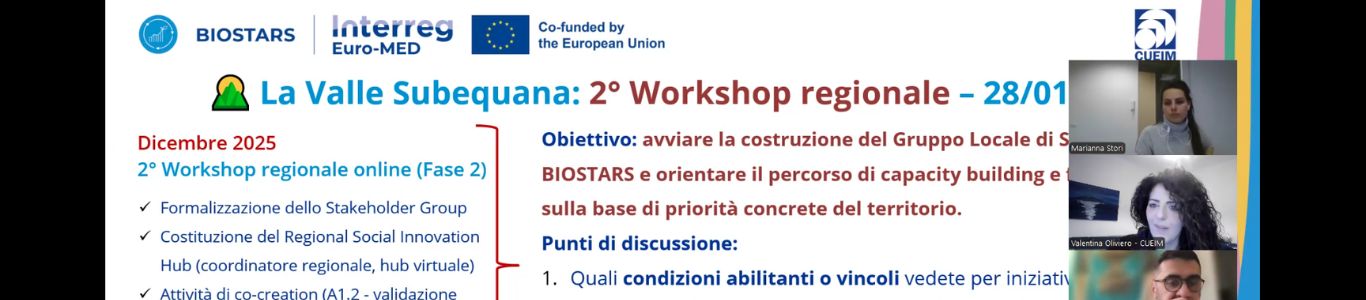

On 28 January 2026, the second regional online workshop of the Interreg Euro-MED BIOSTARS project — organised and coordinated by CUEIM – University Consortium for Industrial and Managerial Economics — brought together key stakeholders from the Subequana Valley.
Building on the initial dialogue launched during the first workshop, this second meeting marked a clear step forward, moving towards a more structured and operational phase of stakeholder engagement within the territory.
The workshop represented a key moment in the consolidation of the local stakeholder group and in the definition of capacity-building and training activities aligned with the concrete needs and priorities of the area.
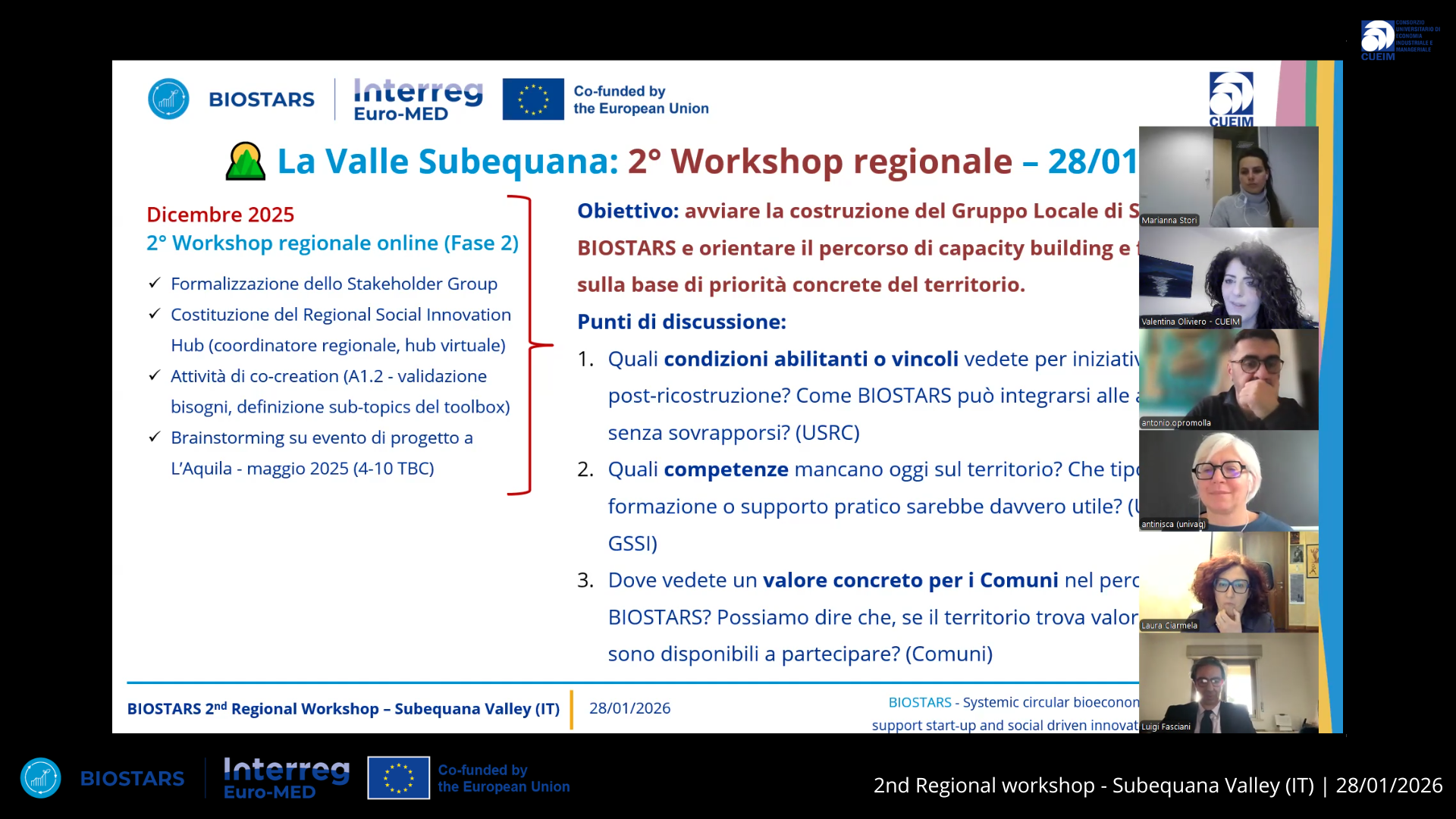
Workshop objectives
The session focused on advancing the creation of a structured local working group, moving beyond initial awareness-raising towards a more active involvement of quadruple helix actors — particularly from the business sector — and strengthening collaboration among public institutions, research organisations and local communities.
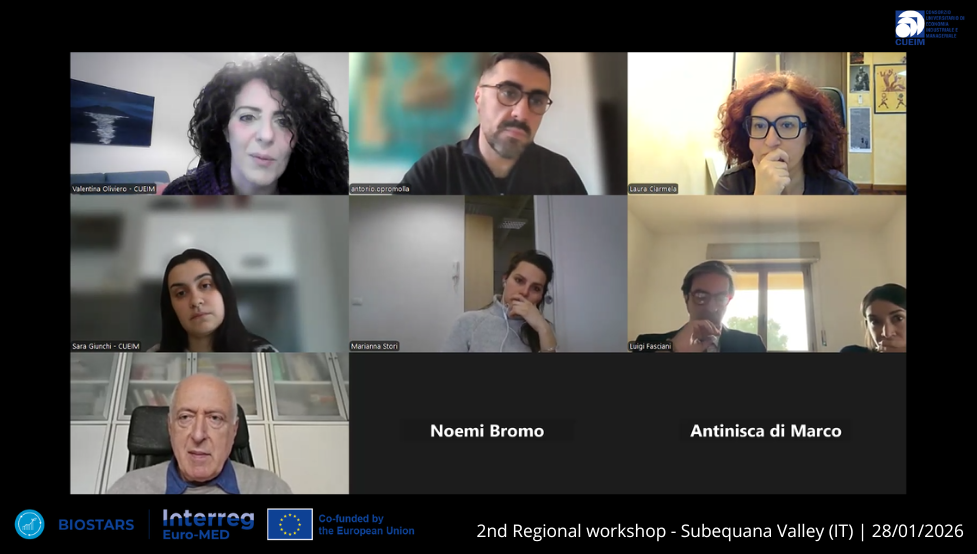
Participants and contributions
The workshop gathered representatives from local authorities, institutional bodies and academia, confirming a growing and increasingly engaged regional partnership.
The Mayor of Molina Aterno, also acting as Commissioner of the Sirentina Mountain Union, highlighted ongoing territorial challenges such as limited service provision and depopulation trends, while reaffirming strong commitment to the BIOSTARS process initiated in the previous workshop.
Representatives from the Special Office for the Reconstruction of the Crater Municipalities (USRC) expressed their support for strengthening local cooperation frameworks, underlining their role in facilitating dialogue with communities and contributing to the visibility and development of inner areas through initiatives such as BIOSTARS.
From the academic perspective, the University of L’Aquila (UNIVAQ), also involved through the “Territori Aperti” project, confirmed its willingness to contribute to the process, particularly in data analysis, participatory methodologies and research on community-based models such as cooperatives.
Compared to the first meeting, the discussion showed a more concrete and solution-oriented approach, with stakeholders increasingly focused on roles, contributions and practical opportunities for collaboration.
The exchange also highlighted the opportunity to extend engagement beyond the Subequana Valley, involving municipalities facing similar socio-economic conditions. At the same time, participants acknowledged the complexity of coordinating multiple ongoing initiatives, emphasising the potential of BIOSTARS to support more structured and integrated training pathways.
From knowledge transfer to local adaptation
It was reiterated that BIOSTARS builds on the experiences of the BIOLOC and REVIVE projects. BIOLOC provides tested rural bioeconomy solutions developed in other European contexts, while REVIVE focuses on territorial development and food community models.
The shared objective is not a direct transfer of solutions, but their adaptation to the specific characteristics of the Subequana Valley through a process of mutual learning, co-creation and local ownership.
Key discussion points
Discussions focused on enabling conditions for post-reconstruction, bio-based development pathways and the need to ensure complementarity between BIOSTARS and existing initiatives, particularly those promoted by USRC.
Participants also reflected on existing gaps, not only in technical skills but also in cultural and behavioural dimensions. From the academic side, particular emphasis was placed on the importance of rethinking development strategies starting from local identity, resources and community practices.
A key priority that emerged was the need to systematise ongoing initiatives—such as green communities, slow mobility and reconstruction-related projects—while strengthening networks and promoting the exchange of good practices among local actors.
The Mayor of Molina Aterno further stressed the strategic importance of enhancing the territory’s distinctive features, particularly its agricultural and livestock sectors, in order to strengthen long-term sustainability and local development pathways. Reference was also made to the National Strategy for Inner Areas (SNAI), which has contributed to reinforcing essential services such as healthcare, education and transport.
Next steps
The workshop further consolidated the BIOSTARS process in the Subequana Valley, reinforcing stakeholder alignment and confirming the transition towards a more structured co-creation pathway.
The next phase will focus on expanding participation and translating emerging priorities into concrete actions. Upcoming activities include in-person meetings scheduled for 6 March in Secinaro and 6–7 May in the Subequana Valley, which will support the consolidation of the local stakeholder group and the refinement of implementation pathways.