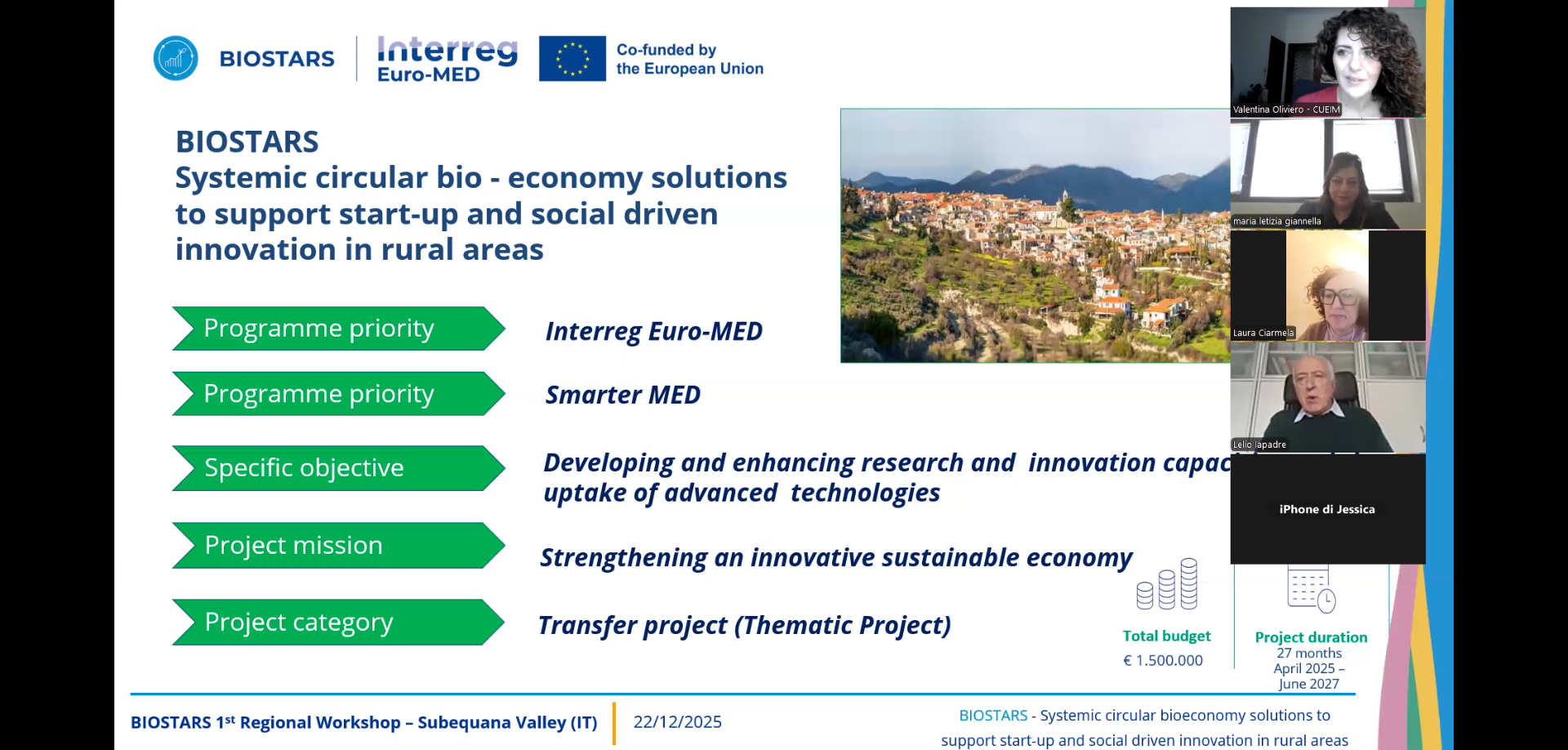
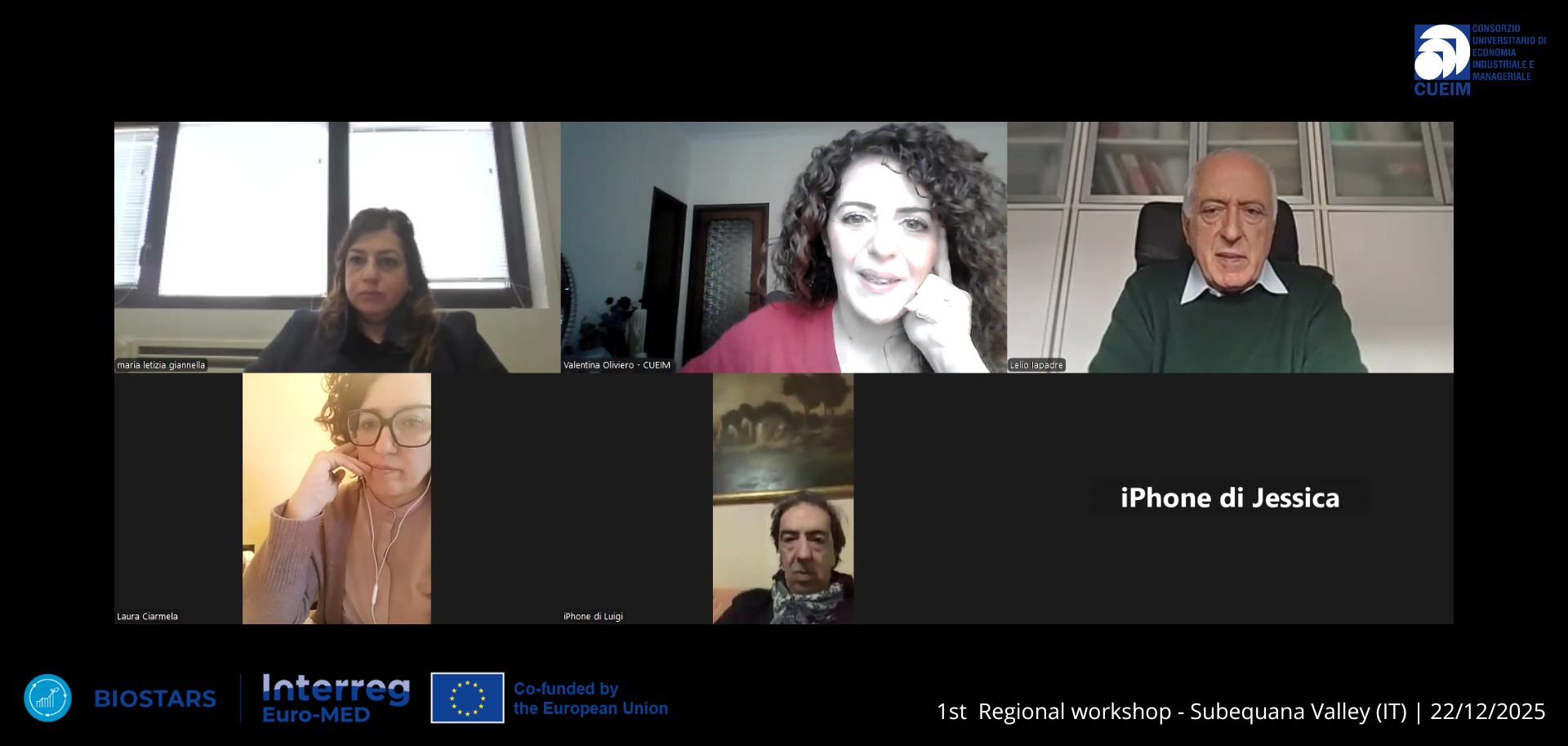
On 22 December 2025, the first regional workshop of the Subequana Valley was held online the Interreg Euro-MED BIOSTARS project, which promotes systemic circular bioeconomy solutions to support start-ups and social innovation in rural areas.
Organised by CUEIM – University Consortium for Industrial and Managerial Economics, the meeting marked the first structured exchange among regional stakeholders. It launched a dialogue with local actors and laid the groundwork for the BIOSTARS co-creation and knowledge transfer process in the territory.
Workshop objectives
The workshop had an introductory and exploratory role and focused on:
- Presenting the BIOSTARS project, its methodology and expected benefits for the Subequana Valley.
- Introducing the transfer approach based on solutions developed within the BIOLOC and REVIVE projects.
- Engaging local stakeholders and initiating a regional working group.
- Paving the way for the creation of a local Stakeholder Group and a Regional Social Innovation Hub.
Participants and approach
The workshop brought together a small but representative group of regional actors, encouraging open discussion and exchange of perspectives. Participants included representatives from local public authorities, universities and research centres, alongside the CUEIM project team.
Among others, the meeting involved the Mayor of Molina Aterno and Commissioner of the Union of Municipalities of the Subequana Valley, as well as representatives of the University of L’Aquila, the Gran Sasso Science Institute (GSSI), and the Special Office for the Reconstruction of the Crater Municipalities (USRC).
The participatory format fostered a constructive dialogue on the socio-economic characteristics of the area, highlighting key challenges such as depopulation, ageing and limited economic diversification, alongside emerging opportunities linked to circular bioeconomy, social innovation and energy communities.
Key discussion points
Discussions were guided by a set of key questions, including:
- Which actors can contribute to the BIOSTARS process at regional level?
- Who are the main beneficiaries of the project activities?
- What barriers could hinder implementation?
- How should the regional working group be structured?
- How can BIOLOC and REVIVE solutions be adapted to the local context?
- What are the main training and capacity-building needs?
Results and preliminary insights
The workshop successfully achieved its main objectives. Participants gained a shared understanding of the BIOSTARS framework and of the key needs and opportunities in the Subequana Valley.
Strong interest and commitment were expressed by local authorities and academic stakeholders, confirming the relevance of the project for the area.
An important outcome was the identification of several ongoing local initiatives, including energy communities, bio-districts, food communities and neo-repopulation projects—that could be aligned with the BIOSTARS process.
The discussion also highlighted the potential of the Subequana Valley not only as a recipient of external solutions, but also as a contributor of good practices and local knowledge to the BIOSTARS ecosystem.
Next steps
As a first, introductory step, the workshop successfully created strong momentum for the BIOSTARS process in the Subequana Valley. It enabled an initial alignment among key regional actors, opened a constructive dialogue and confirmed both the relevance of the project and the willingness of local stakeholders to actively engage in the co-creation process.
Building on this positive start, the next phase will focus on strengthening and expanding stakeholder involvement, while deepening the discussion around local needs, priorities and solutions.
Upcoming activities include the formalisation of the local Stakeholder Group, the launch of the Regional Social Innovation Hub, and the organisation of follow-up co-creation workshops aimed at refining implementation pathways and supporting the scaling of innovative solutions in the territory.
This first workshop marks the beginning of a broader process that will continue in the coming months, gradually moving from initial dialogue to more structured and operational collaboration.